






$20 Minimum Deposit Casino in Australia: Payment Rules
 Available in AU
A $20 floor may come from the payment method rather than the casino, while bonus terms can affect how far a small deposit goes.

Table of Contents
- What a $20 Minimum Deposit Actually Means
- The Payment Method Can Set the Floor
- A Small Deposit, Real-Money Play, and the Practical Catch
- Before You Put $20 Into a Casino
- What “Australian Casino” Means Here
- When a $20 Pokies Deposit Meets Bonus Rules
- Why a $20 Deposit May Not Be the Cheapest Route
- Read the Bonus Conditions Before You Deposit
- PayID, AUD, and the Deposit-to-Withdrawal Gap
- Checking a $20 Deposit on Your Phone
What a $20 Minimum Deposit Actually Means
A “$20 minimum deposit” sounds like a rule set by the casino: pay at least twenty dollars, and the transaction can go through. In practice, that figure may describe the lowest amount accepted through a particular payment route, not a universal minimum imposed by the operator. A payment processor can set its own threshold, so the amount you see at the cashier may depend on how you try to pay.
That distinction is easy to miss. I used to read a minimum as though it were a single number attached to the site. It can be more like a moving floor: the operator may not set one, but the method handling the transaction still may. If its minimum is above the amount you entered, the deposit can be rejected even when the casino’s own rules do not name that amount as a limit.
So when someone says “$20 deposit online casino,” it is worth asking what the twenty dollars refers to. Is it the operator’s stated minimum, a payment method’s minimum, or simply the amount someone chose to deposit? Those are different things. The cashier’s instructions are the practical detail, but the label alone does not tell you which rule is doing the work.
If you’re looking for an Australian casino with a A$20 minimum deposit in 2026, check the stated deposit terms carefully: some operators list a different minimum or a payment-method-specific amount. The details below help you see what is confirmed for each option.
License: Curacao Gaming Control Board OGL/2023/176/0095 (Hollycorn N.V.) LuckyVibe is listed with a Curaçao Gaming Control Board licence, OGL/2023/176/0095, held by Hollycorn N.V.
License: Curacao Gaming Control Board OGL/2023/176/0095 (Hollycorn N.V.) Neospin is listed with a Curaçao Gaming Control Board licence, OGL/2023/176/0095, held by Hollycorn N.V.
License: Curacao eGaming OGL/2023/174/0082 (Dama N.V.) · Min. deposit: A$15 LevelUp Casino lists a minimum deposit of A$15 and a Curaçao eGaming licence, OGL/2023/174/0082, held by Dama N.V.
License: international iGaming licence – jurisdiction not named in the source · Payout speed: PayID 1-24 hours · Min. deposit: A$30 (PayID from A$10) House of Pokies lists a standard minimum deposit of A$30, with PayID deposits from A$10; PayID payouts are stated as taking 1–24 hours. Its source describes an international iGaming licence but does not name the jurisdiction.
License: Curacao Gaming Control Board OGL/2023/174/0082 (Dama N.V.) SpinsUp is listed with a Curaçao Gaming Control Board licence, OGL/2023/174/0082, held by Dama N.V.
License: Curacao eGaming (Roby Games Ltd) Roby Casino is listed with a Curaçao eGaming licence held by Roby Games Ltd.
License: Curacao · Min. deposit: A$20 (POLi) Lucky Dreams lists a minimum deposit of A$20 when using POLi, alongside a Curaçao licence.
Payout speed: crypto under 1 hour, PayID 1-3 business days · Min. deposit: A$20 (A$30 to qualify for the bonus) Ricky Casino lists a minimum deposit of A$20, or A$30 to qualify for the bonus. Its stated payout times are under an hour for crypto and 1–3 business days for PayID.
License: Curacao Gaming Authority (Jumpman Gaming Ltd) DragonSlots Casino is listed with a Curaçao Gaming Authority licence held by Jumpman Gaming Ltd.
Payout speed: crypto 30-120 minutes, fiat 24-72 hours · Min. deposit: A$30 MrPacho lists a minimum deposit of A$30. Its stated payout times are 30–120 minutes for crypto and 24–72 hours for fiat.
For Australian readers, a specialist review describes the effective minimum for a usable deposit as falling between AU$10 and AU$20. Treat that as a reported range, not a fixed market rule: the available payment routes and their conditions can change. It puts a $20 deposit in context without making it a guarantee that every service will accept that amount. Small print matters. Always does.
There is also a difference between a displayed minimum and a usable deposit. The first is a transaction threshold: the smallest amount the cashier says it will accept through a route. The second is the amount that can actually be submitted under the conditions shown at the time. If those figures do not line up, the deposit may fail or the cashier may ask for a different amount. The number in a headline cannot settle that for you.
I would not read a $20 minimum as a sign that a site has assessed what is sensible for a player. It is just a payment condition. Nor does a low threshold mean the transaction is automatically suitable or straightforward. A small number can make a page look accessible, but it tells you nothing by itself about the other terms attached to an account or what happens after a payment is made.
When checking a $20 minimum deposit casino claim, look for the precise wording around the amount and where it appears. A figure in a general description may not be the same as the limit shown at the payment stage. Check whether the cashier identifies the minimum for the selected route, and whether the amount is stated in Australian dollars. A bare “$20” can be ambiguous if the currency is not clear.
It helps to separate three questions in your mind: what amount the operator says it accepts, what amount the payment route will process, and what currency the figures use. If one of those is unclear, the advertised minimum is not enough to make a decision. I have made the mistake of treating a neat number on a page as the whole story. It wasn’t.

A $20 minimum deposit online casino label can therefore be a shorthand, not a promise that every deposit option shares one threshold. The operator’s own rule and the processor’s rule may differ; the effective minimum is the one that applies to the route you select. That is why two descriptions of the same service can appear to give different answers without either necessarily referring to the same payment conditions.
The useful takeaway is modest: treat twenty dollars as a figure to verify, not as proof that a deposit will be accepted. Read the amount shown for the specific route, confirm the currency, and avoid assuming that a minimum listed elsewhere overrides what the cashier displays. It is a small check, but it can save you from confusing an advertised threshold with the actual one. A number is not the whole rule.
The Payment Method Can Set the Floor
A payment screen can make a $20 minimum deposit look like a rule set by the casino. It may not be. The operator can leave its own minimum open, while the voucher or e-wallet you select imposes a lower limit on what you can send. In practice, that payment threshold becomes the floor for the transaction.
I used to look only at the amount shown on the deposit page. That was the wrong place to stop. The useful detail is what happens after you choose a method: the minimum purchase, any transaction fee, and whether the amount you intend to send is accepted. Same deposit figure, different payment route.
Vouchers: the purchase amount matters
With Neosurf, the voucher has to be purchased before it can be used as a deposit. The typical minimum purchase is A$10, so a deposit below that is not available through a voucher at that purchase level. The casino may display a smaller figure, but that does not change what you need to buy first.

For a $20 deposit, the Neosurf minimum purchase does not by itself prevent the transaction: the amount is above that threshold. But don’t treat the voucher’s minimum as a promise that every operator will accept every voucher or set the same deposit options. Check the payment page for the actual amount allowed, and make sure the voucher value matches what you plan to send.
This is where “low minimum” can be a bit of a sales phrase. It describes one part of the route, not necessarily the whole payment. I learned to check the voucher amount before getting one, rather than finding out at the deposit screen that my chosen value did not fit. Annoying, but avoidable.
E-wallets: check both the fee and the floor
Skrill and Neteller can have a different catch. A specialist review reports that deposits to gambling sites through these e-wallets may carry fees and often have a minimum transaction amount of A$10. That is a reported payment condition, not a fixed promise for every account, operator or transaction. The amount and fee can depend on the route you are using, so check the details presented before confirming.
If you are trying to send A$20, a A$10 transaction minimum would not rule it out. A fee could still affect how much leaves your wallet or how much reaches the deposit balance, depending on how the charge is applied. Don’t assume the number entered is automatically the amount credited. Read the confirmation carefully and compare it with the amount shown by the wallet.
There are two separate checks here: whether the transaction meets the minimum, and what the transaction costs. I’ve made the mistake of treating “accepted” as the same as “costs exactly what I entered.” It isn’t always safe to assume that.
What to compare before choosing
For a voucher, start with its purchase minimum and the value you can actually obtain. For Skrill or Neteller, look for the transaction minimum and any stated fee. Then confirm the operator’s own deposit screen accepts that method and amount. The payment provider’s threshold and the casino’s threshold can both matter; satisfying one does not guarantee the other.
The minimum purchase is typically A$10; ensure the voucher value matches your intended deposit.
Skrill and Neteller may have a minimum transaction amount of A$10 and may apply additional fees.
Always verify the casino’s own deposit screen to ensure the chosen method and amount are accepted.
That matters when you are comparing a $20 dollar deposit casino with another site. The phrase “$20 minimum” can refer to the operator’s stated floor, while your payment method may set a separate practical limit. A method that supports a smaller transfer is not automatically cheaper, and a displayed minimum does not tell you whether a fee applies.
My rule now is simple: I check the amount at the payment stage, not just the headline minimum. If the fee or minimum is unclear, I pause rather than guess. Small deposits leave less room for surprises.
A Small Deposit, Real-Money Play, and the Practical Catch
A deposit figure can look impressively low and still tell you very little about what that money will do once it reaches an account. A specialist review has reported that some casinos set a cryptocurrency deposit floor at the equivalent of just A$1. That is a claim about the amount accepted at the deposit stage—not evidence that A$1 is enough for practical real-money play, or that the same threshold applies everywhere.
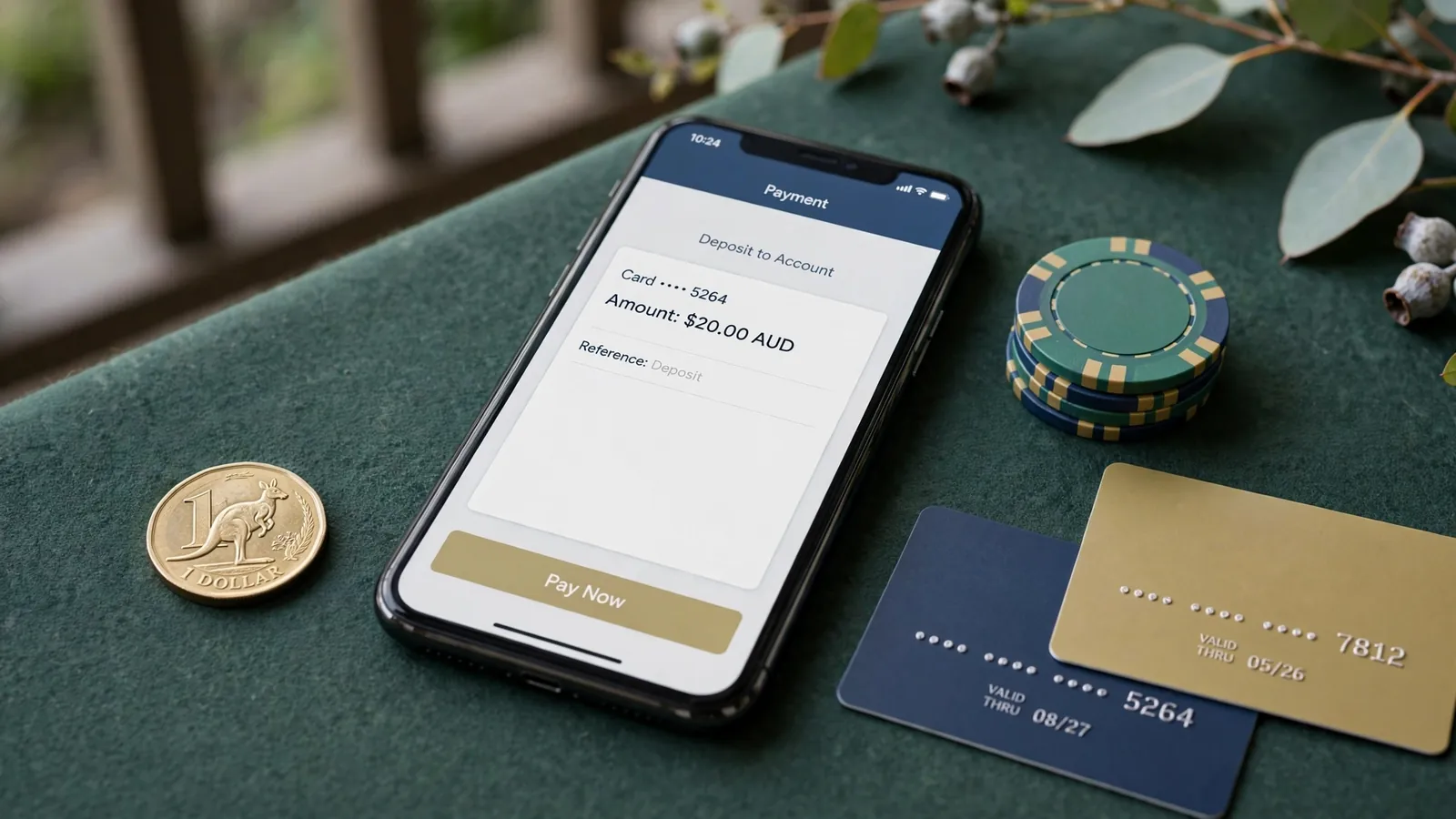
That distinction matters if you are weighing up a A$20 deposit. The amount might clear the payment screen, but the useful balance is affected by the steps around it: moving cryptocurrency, having it credited, and meeting the minimum stake for a game. If any of those steps makes a small balance hard to use, the low advertised threshold is mostly a technical detail.
I have made the mistake of treating “low minimum” as shorthand for “good value”. It isn’t. It only answers one narrow question: what is the smallest amount the system may accept? It does not tell you how much arrives in playable form, how many wagers the balance can support, or whether the available games have stakes that suit it. Small print. Big difference.
With cryptocurrency, transaction costs are part of that gap. A casino may quote its minimum in a tiny equivalent amount, while the transfer itself still has costs. Those costs can take up a larger share of a small payment than of a larger one. The exact result depends on the route and conditions at the time, so a deposit minimum alone cannot tell you what balance will be available after the transaction.
Then there are game minimum bets. Each game sets a floor for a single wager, and a balance that is technically accepted may not leave much room to play if that floor is high relative to the deposit. Even where a game permits a small stake, repeated bets can use up a limited balance quickly. That is not a prediction about what you will win or lose; it is simply the arithmetic of having less money available for each decision.
A A$20 deposit sits in the middle of these issues. It may be enough to pass a payment threshold, but “enough to deposit” and “enough to play comfortably” are different tests. Before treating the figure as a workable budget, check the cryptocurrency transfer cost and the minimum stake on the games you are considering. If those details are not clear before payment, the headline minimum is not a useful measure of the actual cost.
A deposit that clears the payment screen is not the same as a balance sufficient for comfortable play, as transfer costs and minimum game stakes can reduce the usable amount.
There is another wrinkle: a minimum stated in Australian dollars may be applied to a cryptocurrency amount that changes with its exchange value. So the amount you need to send can differ from the round figure you had in mind. Check the amount displayed at the point of payment rather than assuming a nominal minimum converts neatly into a fixed AUD deposit.
I’d read “deposit from A$1” as a narrow payment claim, not a promise that you can make meaningful real-money wagers with that sum. The same caution applies to a A$20 deposit: it can be accepted and still be awkward to use. The practical number is the one left after transfer costs, measured against the actual game stakes—not the smallest number printed beside a deposit button.
That’s the catch.
Before You Put $20 Into a Casino
A $20 deposit tells you what you may be able to pay in. It does not tell you how much you can cash out, or whether a balance of $20 can be sent back to you. I used to treat the deposit box as the important number and leave the cashout rules for later. That’s the wrong order.
One specialist casino review puts the reported minimum cashout range at $20 to $50 AUD. That is a source-specific figure, not a promise that every operator uses those limits. Still, it shows why a $20 deposit can be an awkward starting point: if the minimum cashout is higher than your deposit, the deposit amount alone will not meet it. If the limit is $20, matching it on paper does not guarantee you will have $20 available to cash out.

The balance you see and the amount you can actually request are not always the same thing. A cashout minimum is a separate condition from a deposit minimum. Read both before sending money, and look for the cashout threshold in the operator’s payment terms rather than assuming that a low entry point means a low exit point too. A small deposit can be easy to make and still leave you facing a higher bar to get money back.
Also check which payout route the terms allow. If the rules require cashouts to go back through the deposit method, plan around that before paying. A Neosurf voucher cannot receive a cashout; you would need an alternative payout method. If you deposit with cryptocurrency, the payout should be in the same coin. These details matter because the payment option that gets money in may not itself be suitable for receiving it back.
I would make a simple check before confirming: find the stated minimum cashout, identify the allowed payout route, and compare those terms with the amount you are considering depositing. If the terms are hard to locate or unclear, don’t treat the deposit figure as the full cost of entry. It answers only one question.
The word “low” can be misleading here. A $20 minimum deposit may sound like a small commitment, but that number says nothing by itself about the cashout threshold. A reported range of $20 to $50 AUD is wide enough to change what a $20 starting balance means. At one end, the threshold may equal the deposit; at the other, it is higher. Neither tells you what your eventual balance will be.
A $20 deposit may be easy to make, but if the minimum cashout threshold is higher (e.g., $50 AUD), you may be unable to withdraw your funds without further wagering.
I’ve learned to check the exit before the entrance. Not exciting, but useful. The deposit amount is visible at the point of payment, so it gets attention; cashout terms are easier to overlook until you want your money back. Keep those as separate checks, and don’t assume that meeting the deposit minimum means you can cash out the same amount on demand.
What “Australian Casino” Means Here
“Australian casino” can describe a site aimed at people in Australia, not a casino licensed to provide online casino games under Australian law. That distinction matters when you see a $20 deposit advertised. A local-sounding name, Australian-dollar prices or an AUD deposit option does not change which rules apply.
The federal framework is the Interactive Gambling Act 2001. It prohibits operators from providing real-money online casino games to people in Australia, including pokies, poker and table games. The restriction is on the service being supplied here; it does not make an individual player’s act of placing a bet with an offshore operator a criminal offence. I used to read “available to Australians” as if it meant “approved in Australia”. It doesn’t.
The Australian Communications and Media Authority, or ACMA, oversees compliance with the federal interactive gambling rules and enforces the Act. When it identifies a website offering prohibited gambling services, or advertising them in Australia, it can ask internet service providers to block access. That is one reason an offshore site may be reachable at one point and unavailable later. A blocked page is not just a temporary payment glitch.

ACMA says its enforcement actions have led to more than 1,455 illegal gambling and affiliate websites being blocked since November 2019. It also reports that illegal services have left the Australian market since enforcement began in 2017, but the published totals do not agree: one figure is more than 210 services, while another is more than 190. The discrepancy is worth stating plainly rather than pretending there is a single settled count.
Many sites branded for Australia operate under licences issued offshore, including in Curaçao, Malta or the Isle of Man. Such a licence is not an Australian authorisation to supply online casino games to people here. Nor does a site’s use of “Australian” in its branding tell you that ACMA has approved it. The legal question is what service is being offered to a person physically in Australia, not how the operator labels its page.
So a $20 minimum deposit tells you only what the cashier may accept; it says nothing about whether the underlying service is lawful to provide in Australia. I’ve learned not to treat a low entry amount as a trust signal. It is a payment condition, not regulatory approval.
This is the part I would keep in mind before reading any promotional wording: federal law targets the supply of real-money online casino services to Australians, and ACMA has tools to act against sites and their advertising. A site may still appear online, but access and availability do not turn a prohibited service into a locally authorised one. The label can be misleading. The law is the point.
Legal Status
Under the Interactive Gambling Act 2001, it is prohibited for operators to provide real-money online casino services to people in Australia.
When a $20 Pokies Deposit Meets Bonus Rules
A $20 deposit can look like a modest way to start, but a bonus attached to it may come with a separate workload. The key figure is the wagering requirement: how much must be bet before bonus-related winnings can be cashed out. A specialist review has reported low-deposit bonus requirements ranging from 35x to 50x the bonus amount. That is a reported range, not a promise that every offer uses those terms.
Watch what the multiplier applies to. If the requirement is based on the bonus, a 35x condition means the bonus amount is multiplied by 35 to calculate the required total bets. It does not automatically mean you must bet 35 times your deposit. I used to skim the headline and assume the bonus was simply extra money. It wasn’t that simple.
The game can change how quickly those bets count. Pokies typically contribute their full bet amount towards wagering, while blackjack and roulette may contribute only 10% or 20%. So a bet on a table game can make much less progress than the same-sized pokies bet. Check the contribution rate, not just the game’s name or the size of the bonus.
Here is the catch in plain terms: a large wagering requirement can mean repeated betting before the bonus can be cashed out, and lower game weighting slows progress further. A headline about a “match” tells you little on its own. The multiplier and the games that count are what give it practical meaning.
For a small bankroll, that distinction matters. If you make bets mainly on a game with a low contribution rate, your recorded wagering progress may lag well behind the amount you have actually staked. Switching to pokies may count more towards the requirement, but that does not make the condition easy or guarantee a positive result. It only changes how bets are counted.
I’d treat bonus funds as conditional, not as money already in my balance. Before opting in, I’d check whether the requirement is calculated on the bonus amount, which games qualify and how much each contributes. Those details can turn a seemingly generous offer into a long set of conditions. Read the small print. Then decide.

A $20 entry point and a bonus are separate things: one concerns the payment, the other sets conditions on bonus-related winnings. If the wagering requirement is too demanding for the amount you planned to spend, declining the promotion may be the clearer choice. No bonus is automatically better than playing without one; the terms determine what it asks of you.
Why a $20 Deposit May Not Be the Cheapest Route
A $20 deposit sounds modest, but the payment route can make it an awkward amount to move. I learned not to judge a payment method by the number on the deposit screen alone. With a bank transfer, the money may take several business days to arrive, and your sending bank may charge a fee. That can turn a small top-up into a slow, potentially more expensive transaction.
The delay matters even when the transfer itself seems straightforward. If you want to make a small deposit and get on with your evening, waiting several business days changes the experience. It is not the same as seeing a low minimum and being able to use the funds promptly. I have made the mistake of treating “accepted” as “there when I need it.” Not quite.
Fees are another part of the calculation. A sending-bank fee can apply independently of the casino’s stated minimum. So an online casino with a $20 minimum deposit might accept that amount, while the cost of sending it is affected by your bank’s terms. The deposit figure alone does not tell you what leaves your account in total.
That is why I would not call a bank transfer the cheapest route just because the deposit amount is low. “Cheap” should include both any fee charged by your bank and the time you are willing to wait. If the purpose is to place a small deposit, a delay of several business days can be a poor trade even before you know whether a fee applies.
Before confirming, check whether your bank charges for the transfer and how long the payment may take. Those details can change the real cost of using a bank transfer for a casino with a $20 deposit. The operator’s minimum is only one part of the decision; your bank’s conditions matter too.
I also try to separate a low entry amount from a low-friction payment. They are not the same thing. A casino with a $20 minimum deposit may fit the amount you intend to spend, but a bank transfer can still bring waiting and possible sending-bank charges. If timing matters, account for that before you send the money rather than assuming the transfer will suit your plans.
That is the trade-off in plain terms: a bank transfer may let you make the deposit, but it can take several business days and may cost you a fee at the sending end. For a small amount, those inconveniences can loom larger than the headline minimum. Check first. Then decide whether the route is worth it.
Read the Bonus Conditions Before You Deposit
A $20 deposit can meet the payment minimum and still fail to qualify for a promotion. I’ve learned to check the bonus terms before confirming anything, not after the money is in. The deposit amount and the bonus’s qualifying minimum are separate conditions: make sure the offer accepts a $20 deposit if that is what you plan to put in.
Then look for the wagering multiplier and what it applies to. The wording should say whether it is calculated on the bonus, the deposit, or both. Don’t assume that a headline offer tells you the full requirement. Read the terms attached to the specific promotion.
Game weighting matters too. Pokies may count fully towards wagering, while blackjack and roulette can contribute much less. That difference can change how much qualifying play is needed, so check the weighting for the games you intend to play rather than relying on a broad “all games included” claim.
Check the maximum stake while wagering is active. A promotion may set a limit per spin; if it says $5, going over that amount can void winnings. I used to skim past the small print and focus on the advertised amount. Bad habit.
Bonus Verification
- Check if the $20 deposit meets the qualifying minimum for the promotion
- Identify the wagering multiplier and what it applies to
- Verify the game weighting for the games you intend to play
- Confirm the maximum stake allowed per spin during wagering
- Locate the maximum cashout cap for bonus winnings
Finally, find any maximum cashout cap. A cap can limit what you are allowed to take from bonus play, even if the balance on screen looks higher. Read how the cap applies and whether it covers bonus winnings or the overall balance.
My quick check is: qualifying minimum deposit, wagering multiplier, game weighting, maximum stake, and cashout cap. If any condition is unclear, don’t treat the promotion as straightforward. “Easy bonus” is just a label; the terms decide what it means.
PayID, AUD, and the Deposit-to-Withdrawal Gap
A $20 AUD deposit can sit right at the threshold for a PayID or instant bank transfer. A specialist payment-method review puts the typical minimum for these routes between AU$10 and AU$20, but that is a reported range, not a promise that every payment screen will accept the same amount. The operator or its payment processor may set a different floor, so check the amount shown before confirming.
That matters if you are looking for a $20 PayID deposit: the transfer option and the minimum displayed at checkout need to match. Seeing PayID listed does not, on its own, tell you whether a $20 deposit will go through. Small distinction. Real money.
The deposit-to-cash-out gap is easy to miss. A specialist review of payment timing describes PayID as often same-day for withdrawals, while Tether (USDT) sent over TRC-20 may clear within minutes after account verification. Those are reported timings, not guarantees. Verification can be part of the process, and the stated speed applies after the account has been checked.
I’d treat “instant” as a label to verify, not a clock you can rely on. Deposit speed and cash-out speed are separate things; a quick incoming transfer does not establish when a later payout will arrive. Before using either route, check the payment instructions and whether your account has completed verification. That is the boring bit—and it can decide whether a fast cash-out claim is relevant to you.
PayID and USDT are described in specialist payment reviews as among the faster withdrawal routes, but the details can vary by operator and transaction. If you are comparing a $20 AUD deposit online, make the actual threshold your first check and the stated payout timing your second. A small deposit is only useful if the route works both ways.
Checking a $20 Deposit on Your Phone
A deposit screen can make a $20 payment look like a single yes-or-no decision. I’ve learned to slow down before tapping confirm: the amount shown by the operator is not always the amount the selected payment route will accept. The operator may set no minimum deposit at all, while the payment method or its processor applies a separate floor.
On a phone, check the amount after choosing how you intend to pay, not just the figure displayed on the first deposit screen. Look for a stated minimum beside that method, in its payment instructions, or in the operator’s deposit terms. If the screen says $20 but the selected route requires more, the payment may not go through as expected. If the route accepts less, the operator’s own threshold may still matter. Read both.
I once treated the first number I saw as the whole answer. It wasn’t. A mobile layout can put the payment choice and its conditions in separate places, so don’t assume that a deposit button confirms the amount is eligible. Check the selected method, the currency shown and any minimum stated before authorising anything. If those details are unclear, stop and check the operator’s payment information rather than guessing.
That’s the useful test for a mobile $20 deposit: does the chosen method accept that amount, and does the operator allow it? The answer can change with the payment route, even when you have not changed the amount. A phone makes the process portable, not simpler.
No mystery. Just check first.
What is the actual minimum deposit at a no minimum deposit casino in Australia?
The casino may set no minimum itself, but the payment method can impose one. In Australia, the commonly effective minimum is AU$10–AU$20; some offshore casinos accept deposits as low as AU$5 via cryptocurrency.
Are no minimum deposit casinos legal in Australia?
The Interactive Gambling Act 2001 prohibits providers from offering certain online gambling services to Australian residents, but it does not criminalize an individual for placing a bet with an offshore operator.
What is the minimum deposit and wagering requirements?
The commonly effective minimum deposit is AU$10–AU$20, though it can vary by payment method. Low-deposit bonuses may require wagering of 35x–50x the bonus amount before bonus winnings can be withdrawn.
Do low deposit bonuses have wagering requirements?
Yes, low-deposit bonuses may carry wagering requirements of 35x–50x the bonus amount. Slots typically count fully, while blackjack and roulette may contribute only 10% or 20%.
Can I withdraw winnings from a low deposit?
Yes, but withdrawals commonly have a minimum of AU$20–AU$50, and bonus wagering requirements may need to be met before bonus winnings can be withdrawn.
Prepared by the SpinBetter Casino editorial staff.