






No Minimum Deposit Casinos in Australia: How It Works
 Available in AU
A casino may set no deposit floor, while the payment method still has a minimum that limits what you can send.

Table of Contents
- What “no minimum deposit” actually means
- The Australian rules behind offshore casino sites
- Real-money play: a small deposit is not the whole cost
- Crypto deposits: low on paper, less simple in practice
- PayID, PayPal and other payment routes
- Pokies and crypto: check the real cost of a tiny stake
- Slots, wagering and the small-balance trap
- A “no-deposit” bonus can still come with a big hurdle
- Bitcoin minimums: the number is not the whole story
- PayPal and the limits of what can be verified
What “no minimum deposit” actually means
“No minimum deposit” sounds like a clean promise: put in whatever amount you choose, or nothing at all. In practice, the phrase can describe only one part of a transaction. It may mean the operator has not set its own minimum deposit floor. It does not necessarily mean every payment route will accept any amount, or that a deposit of any size can be made in a useful way.
I used to read the label as if it settled the whole question. It doesn’t. The operator’s rule and the payment method’s rule are separate. An operator might not require a particular minimum, while the processor handling the payment still has a minimum transaction amount. If that payment route will not accept the amount you want to send, the operator’s zero floor does not change the outcome.
That is the gap between a stated minimum and an effective one. A “no minimum deposit” claim can be accurate in a narrow sense and still leave you unable to make a smaller deposit through the method available to you. The amount you can actually send depends on the conditions attached to that route, not just the wording on the casino page.
If you’re looking for a casino with no minimum deposit, check the stated deposit terms before choosing: the available details may identify a minimum rather than confirm that none applies. Use this list as a starting point for checking what matters to you.
License: Curacao Gaming Control Board OGL/2023/176/0095 (Hollycorn N.V.) You can note LuckyVibe’s listed Curaçao Gaming Control Board licence, held by Hollycorn N.V. No minimum deposit information is provided here.
License: Curacao Gaming Control Board OGL/2023/176/0095 (Hollycorn N.V.) Neospin is listed with a Curaçao Gaming Control Board licence held by Hollycorn N.V. The available details do not specify a minimum deposit.
License: Curacao eGaming OGL/2023/174/0082 (Dama N.V.) · Min. deposit: A$15 LevelUp Casino has a stated minimum deposit of A$15, so the available information does not describe it as a no-minimum-deposit option. Its listed licence is Curaçao eGaming, held by Dama N.V.
License: international iGaming licence – jurisdiction not named in the source · Payout speed: PayID 1-24 hours · Min. deposit: A$30 (PayID from A$10) House of Pokies lists a minimum deposit of A$30, or A$10 when depositing by PayID, and PayID payouts of 1–24 hours. Its source describes an international iGaming licence but does not name the jurisdiction.
License: Curacao Gaming Control Board OGL/2023/174/0082 (Dama N.V.) SpinsUp is listed with a Curaçao Gaming Control Board licence held by Dama N.V. No minimum deposit information is provided here.
License: Curacao eGaming (Roby Games Ltd) Roby Casino’s listed licence is Curaçao eGaming, held by Roby Games Ltd. The available details do not state a minimum deposit.
License: Curacao · Min. deposit: A$20 (POLi) Lucky Dreams lists a minimum deposit of A$20 for POLi. The available details do not provide other deposit-method thresholds.
Payout speed: crypto under 1 hour, PayID 1-3 business days · Min. deposit: A$20 (A$30 to qualify for the bonus) Ricky Casino lists a minimum deposit of A$20, with A$30 required to qualify for the bonus. Its stated payout times are under an hour for crypto and 1–3 business days for PayID.
License: Curacao Gaming Authority (Jumpman Gaming Ltd) DragonSlots Casino is listed with a Curaçao Gaming Authority licence held by Jumpman Gaming Ltd. No minimum deposit information is provided here.
Payout speed: crypto 30-120 minutes, fiat 24-72 hours · Min. deposit: A$30 MrPacho lists a minimum deposit of A$30, so the available information does not describe it as a no-minimum-deposit option. Stated payout times are 30–120 minutes for crypto and 24–72 hours for fiat.
The operator’s floor is only one rule
Think of a deposit as passing through two sets of conditions. First, the operator may set a minimum for adding funds to an account. Second, the payment method or processor may impose its own threshold. Either can affect what is possible.
So when a page says there is no operator-set minimum, read that literally: the operator is not imposing a floor of its own. Don’t silently translate it into “every payment method accepts any amount.” Those are different claims.
The same distinction matters when comparing one site with another. A low or absent operator minimum may look attractive beside a higher stated threshold elsewhere, but the comparison is incomplete unless you know which payment routes are available and what limits they apply. A displayed figure can describe the casino’s rule without describing the whole payment process.
I’ve made the mistake of stopping at the headline. It saves time while you’re browsing, then costs it when the payment screen tells a different story. Check the deposit conditions for the specific route you are considering, rather than assuming the general claim covers every option.

What the Australian figure does—and does not—tell you
A specialist review reported that the effective minimum for a usable deposit in Australia falls in the AU$10–AU$20 range. That is a reported estimate, not a fixed rule for every operator or payment method, and it can change. It is useful as a reminder that “no minimum” does not always mean a practical deposit can be made for a negligible amount. It should not be treated as a guaranteed threshold.
The distinction is simple: the casino’s own deposit floor could be absent, while the smallest amount accepted by a payment provider is higher. In that case, the provider’s limit becomes the practical floor for that transaction. A different route could have different conditions. The label alone cannot tell you which situation applies.
This also means that “no minimum deposit” is not a universal feature with one standard meaning across all sites. It might refer to the operator’s terms, rather than the amount a payment processor will accept. If the wording is vague, look for the actual deposit conditions instead of filling in the gaps yourself.
A useful way to read the claim
When you see a no-minimum claim, separate these questions:
- Does the operator set a minimum deposit?
- Does the payment route have its own minimum?
- Do the stated conditions apply to the route you intend to use?
That is not overthinking it. It is just reading the claim at the right level. The phrase describes a threshold—or the absence of one—on the operator’s side. It does not promise that every payment method will process a deposit of any size.
A small number in an advert can make the whole transaction appear simpler than it is. I now treat the headline as a starting point, not a full explanation. If the payment conditions are unclear, the claim has not answered the practical question.
There is one more distinction worth keeping clear: “no minimum deposit” describes depositing, not every other condition attached to an account or payment. It does not, by itself, establish what amounts a provider accepts or what rules apply later. Don’t stretch a narrow statement into a broader promise.
In short, the operator may set no floor, while the payment route still sets one. That is how a no-minimum claim can be technically true without making every small deposit possible. The useful figure is the one that applies to the actual transaction—not just the headline.
The Australian rules behind offshore casino sites
The word “Australian” on a casino’s front page can describe its intended audience, not the law under which it operates. Many sites using Australian branding hold an offshore licence, with Curaçao, Malta and the Isle of Man among the jurisdictions that issue such licences. That does not make the service locally licensed or change the rules that apply to online casino games offered to people in Australia.
The main federal law is the Interactive Gambling Act 2001, usually shortened to the IGA. It remains the central legislation governing online gambling here. The Act makes it illegal for operators to provide real-money online casino services to people physically in Australia. That prohibition covers casino-style games such as pokies, poker, blackjack and roulette. The key distinction is who the law targets: the restriction is on the provision of prohibited services, not a criminal offence created for an individual simply for placing a bet with an offshore operator.

That distinction is easy to miss when a site looks open to Australian visitors. A page may load, show Australian currency or use local language, but access does not establish that the service is permitted under Australian law. Nor does an offshore licence replace Australian authorisation. I have learned not to treat a polished local-facing page as proof of anything beyond the fact that it is trying to reach local players. Appearance is not permission.
The law also does not turn on whether the site calls itself a casino, a gaming club or something else. The substance matters: online casino-style games offered for real money to people in Australia fall within the prohibited-service framework. A foreign licence may be relevant to the operator’s position in the jurisdiction that issued it, but it does not override the Australian rules. So “licensed” can sound reassuring while leaving the most important local question unanswered.
The Australian Communications and Media Authority (ACMA) is the federal regulator responsible for enforcing the IGA and monitoring compliance with federal interactive-gambling laws. Its role is not limited to publishing guidance. Where a website provides a prohibited interactive gambling service, or advertises one in Australia, ACMA can ask internet service providers to block access to it. A block is a practical enforcement measure: it can make a site harder to reach from Australian connections, though it does not change the underlying legal status of the service.
The scale of that work is substantial. Following enforcement action, ACMA has blocked more than 1,455 illegal gambling and affiliate websites since November 2019. It has also reported that services have withdrawn from the Australian market since enforcement began in 2017. The figure for those withdrawals is reported inconsistently: one account puts it at more than 210 services, while another gives a figure of over 190. Either way, the numbers describe enforcement activity over time, not a promise that every prohibited site will disappear or that a site still accessible is lawful.
Legal Status
The Interactive Gambling Act 2001 makes it illegal for operators to provide real-money online casino services to people physically in Australia.
This is where the difference between blocking providers and prosecuting players matters. A person in Australia may encounter an offshore site without that encounter making the person criminally liable for placing a bet. The IGA’s prohibition is directed at operators providing the covered services. That does not mean the arrangement is endorsed, protected or equivalent to using a locally authorised service. It means the legal responsibility described by the Act is not the same on both sides of the transaction.
I would keep those ideas separate rather than compressing them into “offshore casinos are legal” or “players are breaking the law.” The first overstates what a foreign licence does; the second misstates the distinction in the IGA. The precise point is less dramatic: Australian law prohibits operators from supplying these real-money casino services to people here, while the individual act of betting is not criminalised under that prohibition.
A low or absent deposit floor does not alter any of this. Payment terms describe how an operator handles money; they do not determine whether the operator may offer online casino games to Australians. Likewise, a site’s availability, its branding and the country named on its licence are separate from the federal restriction. If you are trying to understand the legal setting, start with the service being offered and the location of the customer, not the marketing language around the site.
The practical picture is therefore not “a local casino with a different licence.” It is a prohibited service supplied from offshore, with ACMA able to pursue enforcement measures such as requesting access blocks. The agency’s actions show that the restriction is actively enforced, even though enforcement cannot be assumed to remove every site at once. Keep the distinction clear. It matters.

Real-money play: a small deposit is not the whole cost
A small balance can look like a way to keep the risk contained. The catch is that the amount you can deposit and the amount that makes a game usable are separate things. A site might describe a low entry point, but that tells you nothing by itself about how many rounds the balance could cover.
The useful figure is the minimum stake for the game, not just the minimum deposit. If the minimum stake takes a large share of what is in the account, the balance may support only a few decisions before it is gone. That can make the advertised entry point feel more like a token than a practical way to play.
I used to treat a low starting balance as a kind of safety rail. It was easy to think, “I can only lose what I put in.” That part is true, but it left out how quickly the balance could be used up. A small amount does not stretch further simply because the deposit screen makes it sound accessible.
The same distinction applies when a casino says there is no minimum deposit. That describes the operator’s deposit rule; it does not mean a real-money game can be started with any balance, or that a small balance will last. The game’s own minimum stake still matters. So does whether you can stop without feeling that the deposit was wasted. That’s the part I missed.
Attention: A low deposit amount does not guarantee a playable session; the game’s minimum stake determines how many rounds your balance will actually cover.
A specialist review has described some casino-set cryptocurrency minimums as low as the equivalent of A$1. That is a claim about a nominal deposit threshold, not a promise that the amount is enough for meaningful play. The practical limit can still be the minimum stake of the game. A displayed balance and a playable balance are not always the same thing.
It helps to think in terms of decisions rather than the number on the deposit page. Before any real-money play, the relevant question is whether the amount you are willing to lose leaves room for more than a handful of minimum stakes. If it does not, there may be little room to make a choice, pause, or change direction once play starts. A tiny balance can narrow those choices.
There is also a difference between “low cost” and “low exposure”. A low deposit limits the amount initially placed in the account, but it does not make gambling a reliable way to earn money. Losing the balance remains a possible outcome, and adding more money to recover it changes the original limit. I learned that the hard way: a small first amount can become a reason to keep going, rather than a firm boundary.
For Australians, there is an important legal context too: the Interactive Gambling Act 2001 prohibits operators from providing real-money online casino games to people in Australia. A low deposit claim does not change that position, and it is not an endorsement of using such a service.
If you are assessing what a “no minimum deposit” claim actually means, separate the deposit threshold from the game’s minimum stake and from the amount you can afford to lose. Those are different figures with different consequences. The smallest number on the screen is not necessarily the number that matters most.
Small balance. Limited room.
Crypto deposits: low on paper, less simple in practice
A crypto deposit can look almost frictionless when the casino’s stated minimum is tiny. That number is only the operator’s threshold, though. It does not tell you how much you need to send, what costs may apply on the way, or how much will arrive in the account.
A specialist review has described some casino-set cryptocurrency minimums as low as the equivalent of AU$1. That is a reported figure, not a dependable offer across operators: minimums can change, and a low threshold does not make a deposit of that size practical. A separate specialist review has reported offshore operators accepting cryptocurrency deposits from AU$5. Treat that, too, as a specific reported example rather than a market-wide promise.

The gap is the part that caught my attention. Crypto moves through a payment network, and a transaction can involve costs outside the casino’s own deposit rule. The amount sent and the amount credited are not automatically the same thing. Depending on the network and the service used, fees or conversion can reduce the value that reaches the casino balance. So when you see a very low minimum, check whether the displayed figure is the amount the casino must receive or simply the minimum it says it will accept.
There is another step before the deposit even leaves your hands: getting cryptocurrency into a wallet and sending it to the address provided. Each stage has its own terms and costs. A casino’s minimum does not tell you what a wallet or exchange will charge, and a casino cannot make those outside charges disappear by advertising a small deposit threshold. Keep that distinction clear.
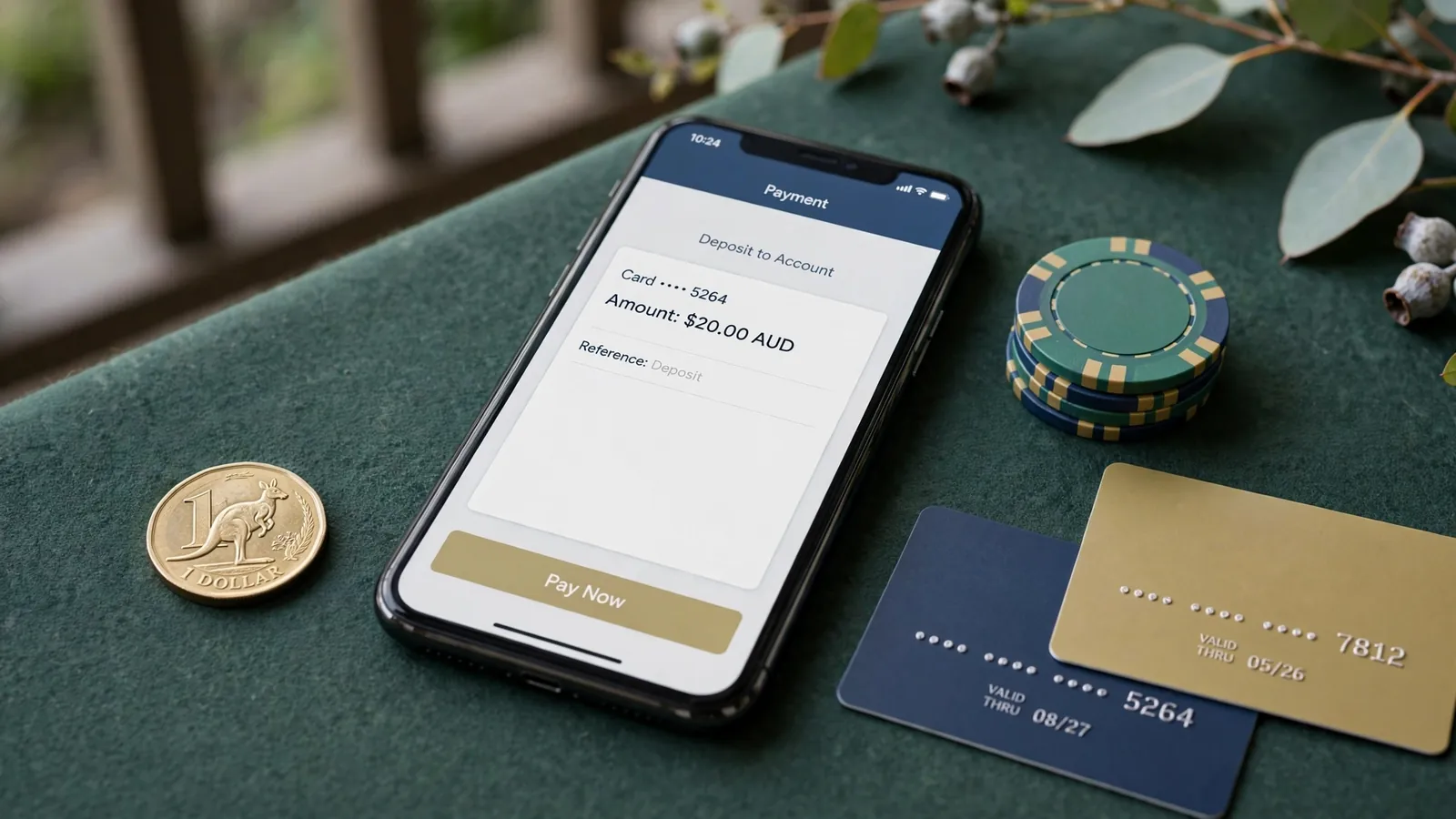
I would also avoid treating a low figure as evidence that a payment route is suitable for a small balance. If costs take a noticeable share of what you intended to deposit, the low casino minimum has done little for you. You are not comparing like with like unless you compare the total amount spent with the final account balance.
Crypto can therefore answer one narrow question—whether an operator’s own deposit floor is low—without answering the more useful one: whether sending a small amount leaves you with a worthwhile balance. The minimum is a doorway, not a measure of value. Small on screen.
Before sending anything, check the casino’s current deposit instructions and the wallet or exchange terms separately. Confirm the required network and address carefully; a mistake in either can create a problem that a low minimum does not solve. Also check whether the account displays the expected currency and credited amount once the transfer is complete. Do not assume a fee is included just because the casino advertises a low threshold.
I keep the operator’s figure in one column and the amount likely to reach the account in another. That is a much less exciting comparison than “no minimum,” but it is the one that tells you whether the deposit is genuinely small.
PayID, PayPal and other payment routes
A payment option can have its own floor even when a casino advertises no minimum deposit. I’ve learned to check the amount shown at the payment step, not just the headline: the operator and the payment provider can set different limits.
For PayID and instant bank transfers, a specialist review puts the commonly reported deposit minimum in Australia at AU$10–AU$20. That is a reported range, not a rule that applies to every service. PayID is also described in specialist reviews as a fast way to receive a cash out, often on the same day. That timing is not a promise; account checks and the operator’s processing can still affect when money arrives.
PayPal is harder to pin down. Check whether it appears in the cashier and read the limit shown there before making a decision. A payment method’s name on a page is not proof that it is available for both deposits and cash outs.
Skrill and Neteller can also be less useful for very small amounts than their digital-wallet labels suggest. A specialist review reports that gambling-site deposits through either may carry fees and often have a AU$10 transaction minimum. If a fee applies, the amount leaving your wallet and the amount credited to the account may not match. Check the fee and the minimum together; one without the other gives you an incomplete picture.
Neosurf has a more direct threshold: the voucher purchase is typically AU$10, which effectively makes that the smallest deposit through the route. Buying a voucher below that amount is not an option if the minimum purchase applies. And a voucher deposit does not mean a cash out can go back to the voucher; you may need another route for receiving funds.
A regular bank transfer is the awkward choice when the aim is to move a small amount quickly. Processing can take several business days, and the sending bank may charge a fee. By the time the transfer clears, the convenience of keeping the deposit small can be outweighed by the delay or cost.
Commonly reported deposit minimums range from AU$10–AU$20, with cash outs often arriving on the same day.
Often have a AU$10 transaction minimum and may carry additional fees.
Vouchers are typically purchased at AU$10, which effectively sets the minimum deposit for this route.
For cash outs, specialist reviews describe PayID as often same-day. They also report that USDT sent over TRC-20 can clear in minutes after account verification. Those are reported timings, not guarantees, and they depend on verification being complete.
I’d compare the payment screen’s minimum, any fee, and the cash-out route before sending money. Small print matters.
Pokies and crypto: check the real cost of a tiny stake
A tiny crypto deposit can look like a neat way to try pokies without putting much money in. But the deposit threshold and the cost of taking part are two different things. The first is the amount an operator says it will accept; the second depends on what each spin costs and how many you can afford before the balance is gone.
A specialist review has reported that a casino-set cryptocurrency minimum can be as low as the equivalent of AU$1. Treat that as a reported figure, not a promise that every operator accepts that amount or that it will buy a meaningful session. The amount credited may also be affected by transaction costs. A low number on a deposit screen is only the starting point.

I used to see a low minimum and assume the account would be easy to test with a small balance. That was the mistake: I was looking at the number going in, not how quickly it could be used. With pokies, each spin deducts a stake. If the minimum stake is large relative to your balance, there may be very few spins available; if the game offers different stake settings, the smallest one is the relevant figure to check. A nominally open door can still lead to a short session.
Before deciding whether a crypto deposit is usable, check the minimum stake for the specific game, not just the casino’s deposit page. Then consider whether the balance left after any transaction costs can cover more than a token attempt. If the site does not show the game’s minimum clearly, you cannot work out the practical value of its advertised deposit floor in advance.
That distinction matters when you see “no minimum” in a headline. It may describe the operator’s own deposit rule, while the payment method and the game each place their own limits on what happens next. Crypto can make the first threshold look especially small, but it does not make the spins themselves cheaper.
I also wouldn’t treat a small balance as a way around the basic risk: a run of spins can use it up quickly, and there is no reliable way to stretch it. The sensible comparison is not “Can I send this amount?” but “What would this balance actually let me do?” If the answer depends on assumptions about the game, pause and check the stake information first.
Small on paper. That’s all.
Slots, wagering and the small-balance trap
A small balance can look easier to manage, but it does not tell you how quickly wagering progress will build. The game you choose matters because casinos can count different games at different rates toward a wagering requirement.
Game Weighting
Different games contribute differently to wagering requirements: pokies commonly count at 100%, while blackjack and roulette may only count at 10% or 20%.
Pokies are commonly credited at 100%: a qualifying bet counts in full. Blackjack and roulette may count at only 10% or 20%. So the same amount staked can make very different progress, depending on the game. I learned that the hard way. I focused on the balance and barely looked at the weighting.
That distinction can make a bonus feel deceptively simple. If you prefer table games, their lower contribution may mean your play adds progress much more slowly than pokies play would. Switching games just to chase a higher contribution is no free fix, either; you still have to follow the offer’s rules, and the game itself carries risk. The percentage is about how the operator counts eligible bets, not how likely you are to win.
Before accepting an offer, find the game-weighting terms and check which games qualify. Read the wording for the specific promotion rather than assuming that every game in a category is treated identically. Also check any maximum stake rule: if an offer sets a cap per spin, going over it can void winnings. A higher contribution rate does not cancel that condition.
I used to treat a low starting balance as a reason to skip the fine print. It was the opposite: with little room to absorb losses, the rules mattered more. A game that contributes less can stretch out progress; a game that contributes more can still burn through a small balance. Neither weighting nor a bonus label makes the money safer.
So if you are comparing offers linked to pokies, look past the headline and ask how those bets count, what games are excluded, and whether a stake limit applies. Then decide whether the terms suit how you actually play. “Counts fully” sounds generous. It is only a counting rule.
A “no-deposit” bonus can still come with a big hurdle
The phrase “no-deposit bonus” sounds like money you can collect without putting anything in. That is not the same as cash you can cash out. A bonus can sit in your account while its terms require you to place a substantial amount of bets before any resulting winnings become eligible for withdrawal.
A specialist review reports wagering requirements of 35x to 50x the bonus amount for low-deposit bonuses. Treat that as a reported range, not a fixed rule: the terms of an individual promotion are what matter. The multiplier tells you how much betting is required relative to the bonus, not how much you will win or how much you can eventually take out.
The arithmetic gets ugly quickly. At 35x, a $1,000 bonus would require $35,000 in total bets before bonus winnings could be withdrawn. That is the total amount wagered, not a target balance you need to build. Reaching it also does not guarantee a profit; the balance can fall while you work through the requirement.
I have made the mistake of reading the bonus figure first and the conditions later. The headline feels concrete; the wagering requirement is the bill hidden behind it. Small print matters.
Before accepting any promotion, check the multiplier and whether it applies to the bonus, the deposit, or both. Then look for the maximum cashout and the maximum permitted bet while the requirement is active. A cap can limit what you receive, and exceeding the allowed stake can void winnings. Those conditions can turn a bonus that looks generous into a poor trade.
- Check the wagering multiplier
- Verify the maximum cashout limit
- Read the maximum permitted bet rule
- Assume a bonus is free money
- Ignore the expiry restrictions
- Overlook the total amount required to wager
A “withdrawable” label is not enough on its own. Check what has to happen before cashout is allowed, and whether the bonus has an expiry or other restrictions. If the requirement is too large to complete on the stated terms, declining the promotion may be the simpler choice. No free money.
Bitcoin minimums: the number is not the whole story
A Bitcoin deposit can look almost frictionless when the casino’s own stated floor is tiny. A specialist review described crypto minimums as sometimes reaching the equivalent of AU$1. That is one reported figure, not a dependable Bitcoin minimum across casinos, and it does not tell you what a particular wallet or payment route will accept.
The casino’s number is only one part of the calculation. A Bitcoin transaction can involve costs that reduce the value reaching the account, so the credited balance may be less useful than the deposit figure suggests. I would not treat a displayed minimum as proof that sending that amount makes practical sense.
Then there is the game itself. If the available balance is small, minimum bets can leave little room to play; the nominal deposit floor does not change those stakes. A balance that technically clears the cashier’s threshold may still be too limited for the games you intended to try.
That’s the catch.
When I see “no minimum” beside a Bitcoin option, I read it narrowly: the operator may not set a meaningful deposit floor, or may advertise a very low one. It does not establish that every Bitcoin wallet can send that amount, that transaction costs are negligible, or that the resulting balance will go far. Those details need checking against the payment instructions and game rules shown for the specific service.
I would also separate a Bitcoin figure from a general crypto claim. Different currencies and networks are not interchangeable, and a stated crypto minimum does not verify a Bitcoin-specific threshold. If the cashier gives no clear Bitcoin instructions, the sensible conclusion is not to guess.
A low number can be technically real and still be a poor guide to what you can actually do with the funds. Check the amount that will be credited, any stated transaction cost, and the minimum bet before deciding whether the deposit is usable. The headline is not the balance.
PayPal and the limits of what can be verified
I can’t give you a reliable PayPal deposit minimum for an Australian online casino, or say that PayPal is available at a particular site. Those details depend on the operator and payment arrangements, and they can change. A page calling something a “no minimum deposit PayPal casino” does not, by itself, establish either that PayPal is accepted or that a PayPal payment can be made for any amount.
There are two separate limits to keep straight. A casino may set no minimum of its own, while the payment method or processor still sets a floor for a transaction. That distinction matters with PayPal just as it does with any other payment route. If an operator says its own minimum is zero, that tells you nothing conclusive about the minimum imposed by the payment service.
I’ve learned not to treat a payment logo or a broad claim as the full terms. Before relying on a PayPal option, check the operator’s current cashier and payment conditions for whether PayPal is listed, what deposit amounts are accepted, and whether the stated terms apply to Australian customers. If those details aren’t clear, don’t assume a low or zero minimum.
Cash-outs are a separate question. A deposit method being mentioned does not establish how a cash-out works, how long it takes, or whether the same method can be used. I wouldn’t infer any of those rules from a claim about deposits.
“Zero minimum” sounds simple. The payment route may not be. A practical answer needs to come from the current terms for the specific transaction, not from the wording of a headline. I’d check before entering payment details, and stop if the conditions don’t explain the limits plainly.
What is the actual minimum deposit at a no-minimum-deposit casino in Australia?
A usable deposit commonly has an effective minimum of AU$10–AU$20, although some offshore casinos accept cryptocurrency deposits as low as AU$5. The amount depends on the payment method and its limits.
Are no-minimum-deposit casinos legal in Australia?
The Interactive Gambling Act 2001 prohibits operators from providing certain real-money online casino services to people in Australia. It does not make an individual’s act of betting with an offshore operator a criminal offence.
What payment method is best for small deposits in Australia?
Cryptocurrency can allow deposits as low as AU$5, but transaction costs may make very small deposits less practical. Neosurf typically starts at AU$10, while Skrill and Neteller often have a AU$10 minimum and may charge fees.
What is the minimum deposit and wagering requirements?
A usable deposit commonly starts at AU$10–AU$20, though the payment method can affect the minimum. Low-deposit bonuses may require wagering of 35× to 50× the bonus amount before bonus winnings can be withdrawn.
Do low deposit bonuses have wagering requirements?
Yes, low-deposit bonuses may have wagering requirements of 35× to 50× the bonus amount. Slots typically count fully toward the requirement, while blackjack and roulette may count only 10% or 20%.
Can I withdraw winnings from a low deposit?
Yes, but withdrawals commonly have a minimum of AU$20–AU$50. If you accepted a bonus, you may also need to meet its wagering requirements before withdrawing bonus winnings.
Can I legally deposit and withdraw money to online casinos?
The Interactive Gambling Act 2001 prohibits operators from providing certain online casino services to people in Australia, but it does not make an individual’s act of placing a bet with an offshore operator a criminal offence.
Written by the editors at SpinBetter Casino.